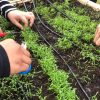

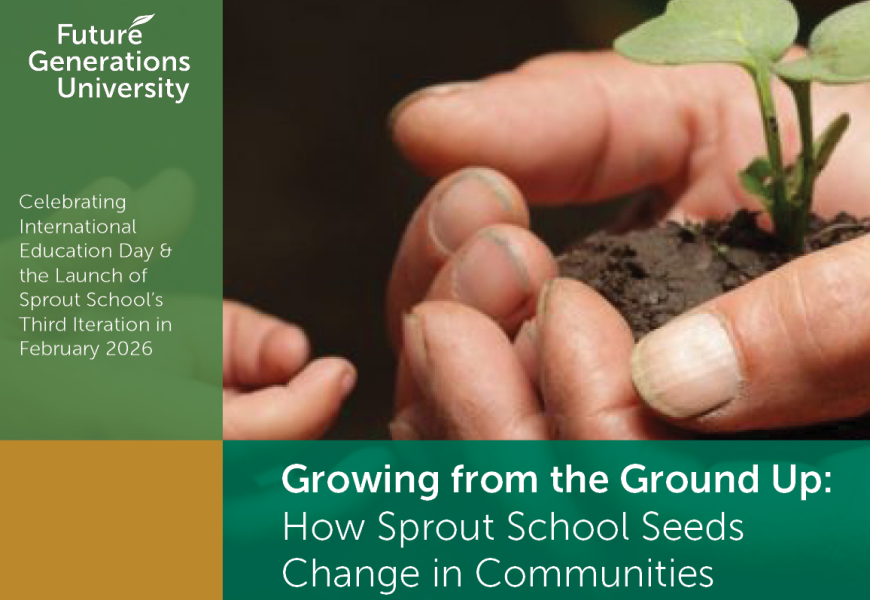
Each January, International Education Day reminds us that education is far more than lessons taught in classrooms — it’s about the ability to grow ideas, confidence, and community. For Future Generations University, that principle is lived out through the Sprout School, a nine-month professional learning program that cultivates the connection between schools, local food systems, and youth leadership.
As Sprout School prepares to launch its third iteration in February 2026, two previous attendees — Sherry Mitchell and Noel Mitchell — reflect on how the program helped them reimagine education in their communities. Their journeys, one rooted in community-led agriculture and the other in formal classroom instruction, reveal how learning that begins with a single seed of curiosity can blossom into systems change.
What is Sprout School?
Built on the USDA’s Farm to School framework and Future Generations University’s global approach to community-based learning, Sprout School is a nine-month professional program open to participants from anywhere in the world.
Each cohort brings together educators, community partners, and changemakers who share a belief that connecting people to food, land, and learning can transform lives. Over the course of nine months, participants meet in bi-weekly virtual sessions and complete 4 hands-on “Learning Labs”, while receiving individualized mentorship to guide them through the design and implementation of their own project.
Every Sprout School journey looks different. Some participants create formal education programs inside classrooms, while others develop informal community learning projects — from youth farm days and school gardens to intergenerational food education or policy initiatives. The common thread is a commitment to helping young people of any age understand where their food comes from, and to strengthening the connections between local food systems, sustainability, and education.
Sprout School helps participants grow from what already works in their communities. Each graduate leaves with more than a plan — they gain a network, renewed confidence, and the tools to cultivate lasting change through learning. One recent participant who entered her cohort knowing exactly what project she wanted to do was still surprised by the deep connections she made through the program.
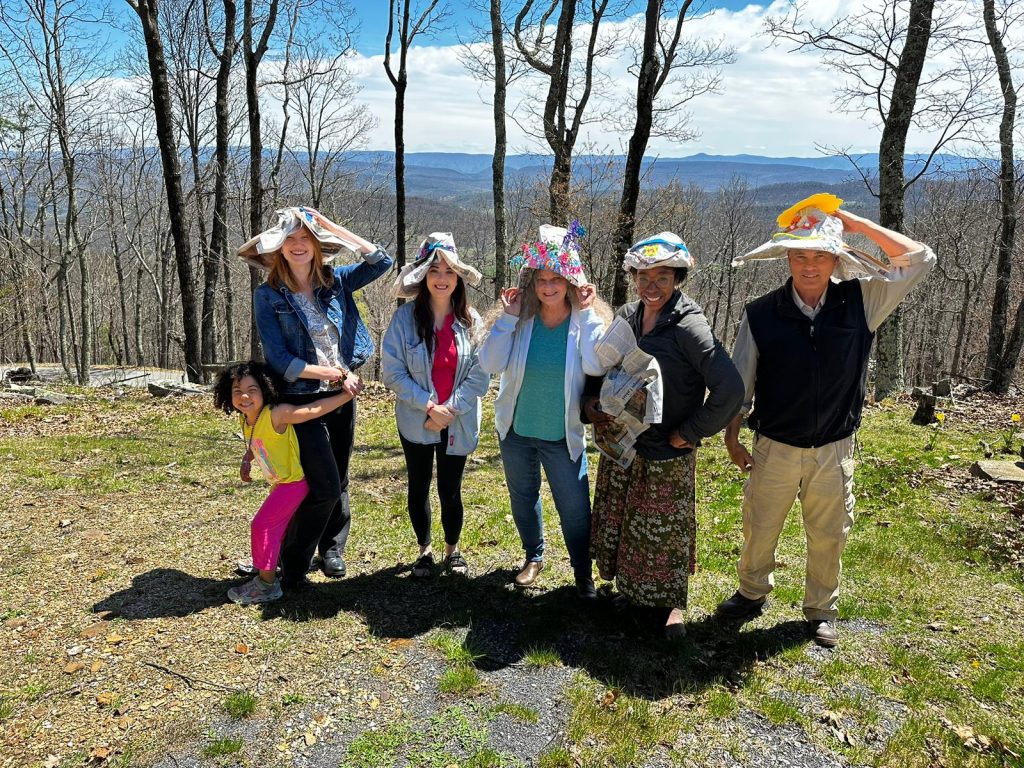
Sherry Mitchell: Cultivating Connection Through Community Agriculture
When Sherry Mitchell, a Planning Coordinator with the West Virginia Department of Agriculture, joined Sprout School in 2024, she was looking for a way to bridge her professional work in agriculture with her personal passion for flowers and community.
“I knew I wanted to bring my local community together around something agricultural,” she recalled. “At first, I thought I’d tie it directly to my department’s work. But the more I got into Sprout School, the more I realized I wanted something that stayed ours — something community-driven and not institutional.”
Her idea grew into a local “Farm Crawl,” where residents could tour nearby farms, experience pollinator projects, and meet the people growing their food. It was a simple idea that turned into something transformative.
But the journey wasn’t straightforward. “At one point, I almost dropped it,” she said, laughing. “I get anxious about projects — I freeze, overthink. But the way the program was structured really helped. The instructors met me where I was. It wasn’t high pressure. It was friendly accountability, and that kept me going.”
Sprout School’s flexible structure — with coaching from subject-matter experts and peer discussions that emphasize reflection — allowed Sherry to pivot her project midway through. She shifted from a department-led initiative to an independent community event built around her own flower farm and local partnerships.
What she discovered along the way was how much her work resonated with others. “I was worried about not having enough flowers because it was a terrible growing year,” she said. “But people kept saying, ‘This is beautiful. You have so many flowers.’ I realized that sometimes we underestimate what we already have — and that was a huge lesson.”
Her project’s success wasn’t just measured by attendance. It was in the connections it fostered: local Rotarians launching pollinator gardens, adults learning about milkweed, and families realizing how agriculture already shapes their community. “There were full-circle moments,” she said. “People came to my farm, met Rotary members, and ended up joining their workshops. It turned into this web of collaboration.”
Looking ahead, Sherry plans to expand the Farm Crawl and bring in more partners — from local restaurants to dairy producers. “Agriculture isn’t just growing tomatoes,” she said. “It’s horses, pollinators, local markets, restaurants that source nearby — it’s community. If someone wants to come pitch a tent to teach kids about birdhouses, I’ll say yes. Anything that grows community belongs here.”
Noel Mitchell: Bringing Farm-to-School to the Classroom
While Sherry’s story blossomed outside the classroom, Noel Mitchell’s project grew directly from it.
As a Health Educator with WVU Extension, Noel had years of experience teaching nutrition in elementary schools. When she enrolled in Sprout School, she hoped to expand her work into gardening — but didn’t realize it would reshape how she approached curriculum itself.
“I didn’t come in with a concrete project,” she said. “I just knew I wanted to get more involved in gardening education. It wasn’t until the sessions started that I realized — wait, this could actually be my Sprout School project.”
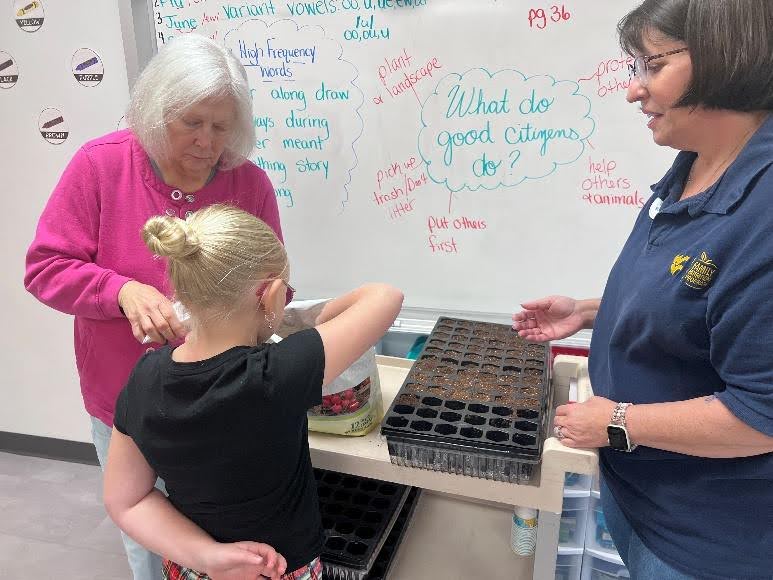
Working closely with her local school district’s Nutrition Director, Noel designed a comprehensive Farm-to-School curriculum that tied together three hands-on programs: monthly taste tests of fresh produce, classroom gardening activities, and “pop-up farmers markets” where students could select and take home fruits and vegetables.
“The idea,” she explained, “was that if kids grow it or pick it themselves, they’re more likely to eat it. So we gave them both experiences — learning about food in class and engaging with it directly.”
Noel’s project was intended to serve second graders, but its impact extended much further. By documenting her process and formalizing it into a replicable curriculum, she ensured that future educators and AmeriCorps members could carry it forward.
When her position was unexpectedly cut due to funding changes, Noel ensured her work would live on. “We printed and distributed copies of the curriculum to the second-grade teachers,” she said. “Even though I couldn’t stay to see it through, the materials are there — and that’s what matters.”
The project’s influence is already spreading beyond her county. The local Nutrition Director presented it at the West Virginia Farm to School Conference in November 2025, showing how Sprout School projects can ripple outward through networks of educators and administrators.
Noel, who recently moved to Florida for a new position with the U.S. Navy’s Child and Youth Programs, says the experience changed her professional lens. “The program really helped me slow down and think more intentionally,” she said. “It’s hands-on, step-by-step, and it reminded me that doing something well doesn’t have to be complicated. You just have to be deliberate.”
She hopes to adapt the curriculum to Florida’s climate and continue connecting children to local food systems. “It’ll be different — more heat, more humidity,” she laughed. “But the principles stay the same: connecting kids to the food they eat, the soil beneath their feet, and the community that grows it.”
Education as Cultivation
Both Sherry and Noel’s stories demonstrate what Future Generations University believes at its core: that education is most powerful when it grows from within communities.
In Sprout School, “students” aren’t just learners — they’re cultivators of change. Each participant builds something uniquely suited to their context, guided by principles that define the university’s global work:
- Growing from success: Starting with what works in local contexts.
- Three-way partnerships: Connecting communities, government, and outside expertise.
- Evidence-based decisions: Using data and reflection to refine projects.
- Behavioral change: Empowering people through action, not dependency.
Sprout School embodies these principles in miniature — each project is a seed that, when nurtured, grows into local systems change.
Program facilitator Jenny Totten describes it this way:
“We want participants to see that education isn’t limited to a classroom or a farm. It’s the bridge between them. Sprout School gives educators the tools and the community to make that bridge real — and lasting.”
Looking Ahead: Sprouting the Next Generation
As Sprout School prepares for its third cohort in February 2026, the vision continues to expand. Participants will again engage in bi-weekly sessions, Learning Labs, and personalized coaching, diving into topics from sourcing local food to youth agricultural entrepreneurship and policy innovation.
The goal isn’t just professional development — it’s transformation. Graduates leave not only with a plan, but with a network of peers who support and inspire one another long after the program ends.
Noel called that network “one of the best parts.”
“The get-togethers and peer learning weren’t mandatory,” she said, “but they were the best part. It was so motivating to see what others were doing and realize we were all growing something — just in different ways.”
That spirit — collaboration across difference — lies at the heart of International Education Day. Around the world, educators are rethinking how to make learning more inclusive, local, and alive. For Future Generations University, Sprout School is one living example of how that happens: a place where learning quite literally takes root.
Join the Next Cohort
The third Sprout School launches February 17, 2026. If you’re an educator, community organizer, or advocate for sustainable food systems, we invite you to grow with us.
Together, we’ll continue proving that education — when nurtured with care, creativity, and collaboration — can change entire ecosystems.
Learn more and apply at: https://www.future.edu/sprout-school/