
What happens when an elephant tramples your crops, or a troop of monkeys gets too close when you’re collecting firewood to cook your family meal? These wild encounters are always unexpected, and yet are regular occurrences for inhabitants – and in particular women – living in the Meghauli Buffer Zone in Chitwan, Nepal. Alumna and project lead Gauri Malakar has made it her life’s work to promote peaceful human-wildlife coexistence, and this year she was awarded the 2026 Davis Peace Prize to scale up her efforts through her Women, Nature and Peace Initiative to advance women’ s empowerment in her community and region.
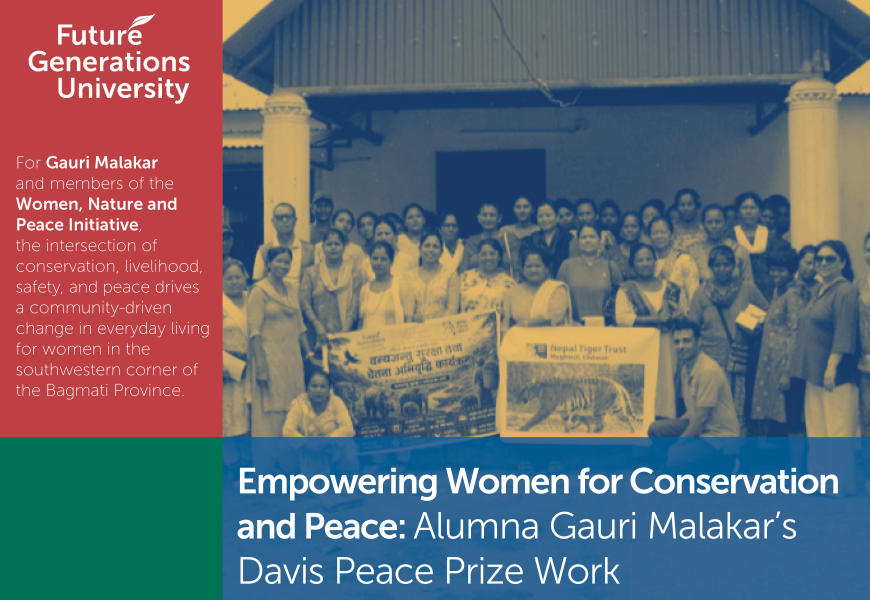
For Gauri and members of the Women, Nature and Peace Initiative, the intersection of conservation, livelihood, safety, and peace drives a community-driven change in everyday living that provides greater preparedness, confidence, and resources to women in the southwestern corner of the Bagmati Province. In an area exposed to such great natural risk and disaster, the work of the Women, Nature, and Peace Initiative establishes peacebuilding as an interconnected part of a community’s wellbeing alongside conservation, livelihood, and overall safety.
A Land where Wilderness and Farms Meet
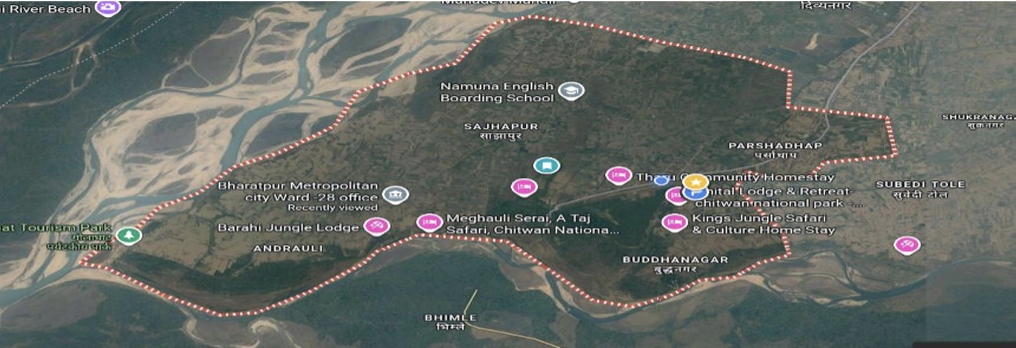
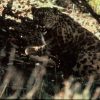
The Meghauli Buffer Zone exists within a conservation landscape where settlements, farmland, forests, rivers, and wildlife habitat all border Chitwan National Park. Unexpected wildlife encounters, limited access to practical safety information and crop damage have a daily impact on the community members – specifically women, who carry the daily tasks of farming, household work, forest resource collection and community activity. The animals in this area, like wild boar, deer, monkeys, rhinos, and elephants, represent great risk to crop damage and safe collection of forest resources, like firewood and fodder. At the same time, the women of these communities have expressed a lack of confidence in natural disaster and emergency preparedness.
Enter: The Women, Nature and Peace Initiative.
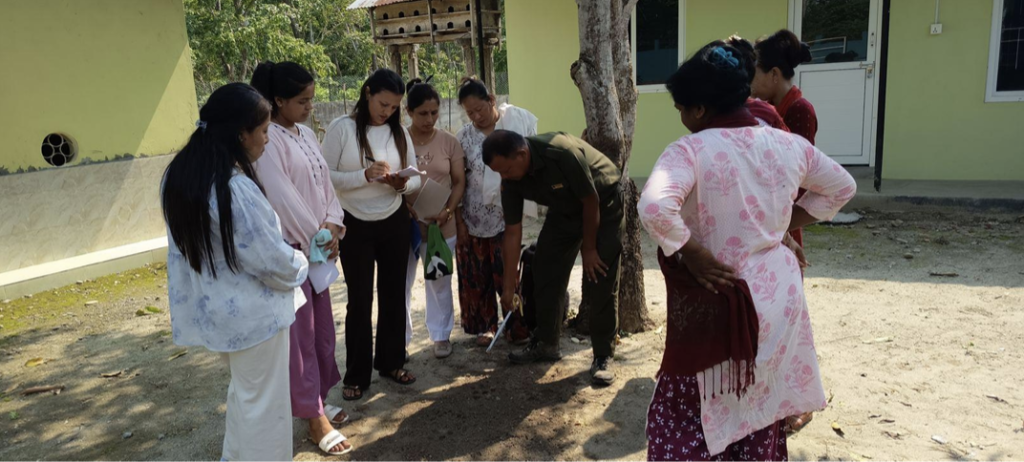
The Initiative is built on the recognition that human-wildlife coexistence cannot be solved solely through wildlife awareness, but that it calls for a combination of community safety, women’s participation, local knowledge, fairness, and shared responsibility across communities, conservation institutions, government bodies, and stakeholders.
Gauri’s goal is to achieve awareness and confidence in conservation efforts, develop practical livelihood skills, and establish a women-led community seed bank. This led her to establish “The Women, Nature and Peace Initiative.” Utilizing her expertise in the SEED-SCALE framework (integral to her MA degree at Future Generations University), she developed the initiatives methodology to consist of: listening, learning, practicing, and analyzing. Through the Davis Peace Prize award, she ran the initiative’s programs from May-August of 2026.
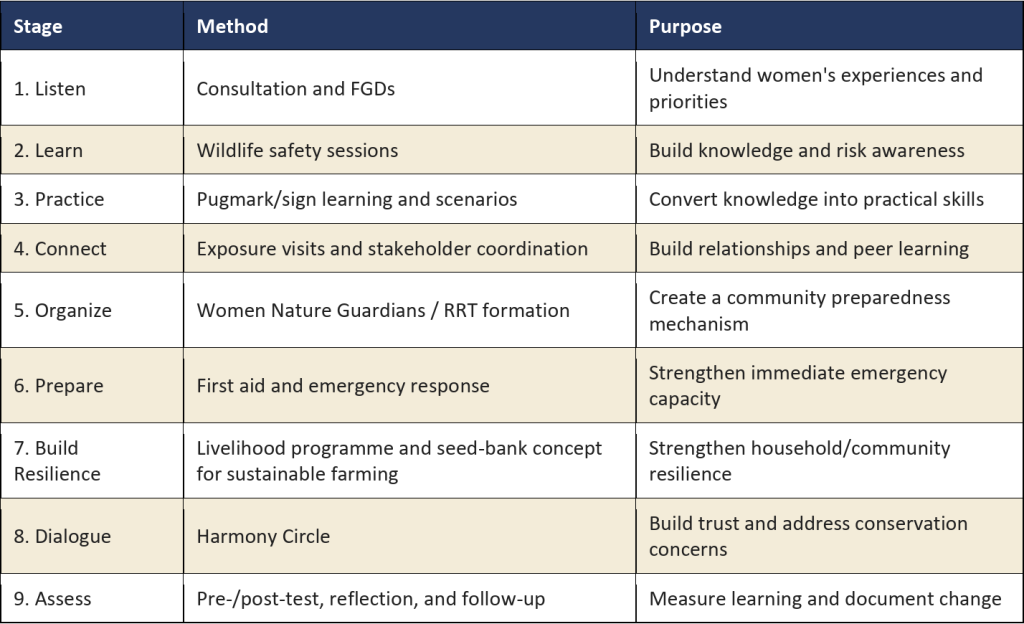
Each stage is participatory by design. Community members who participate engage in women-centered, community-based conversations that ground them in a better understanding of real experiences. Through their participation, women build partnerships, expand their knowledge and capacity for risk awareness and preparedness, develop practical and repeatable skillsets, and develop benchmarks by which to measure their continued learning and growth.
Conversations are an essential component to the Initiative’s success; Gauri complements them with hands-on learning activities that empower community members in real time.
Applied Activities that Drive Learning and Connection
The need for information, training and education, and community discussion are paramount to the livelihoods of the women in these areas. As such, Gauri, partnering with individuals and organizations including the Nepal Tiger Trust Team, implemented a series of activities to address these needs.
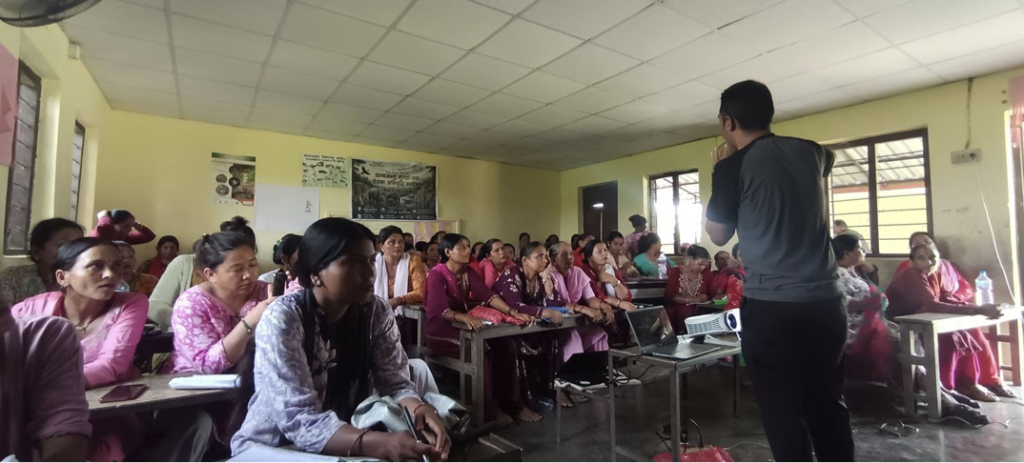
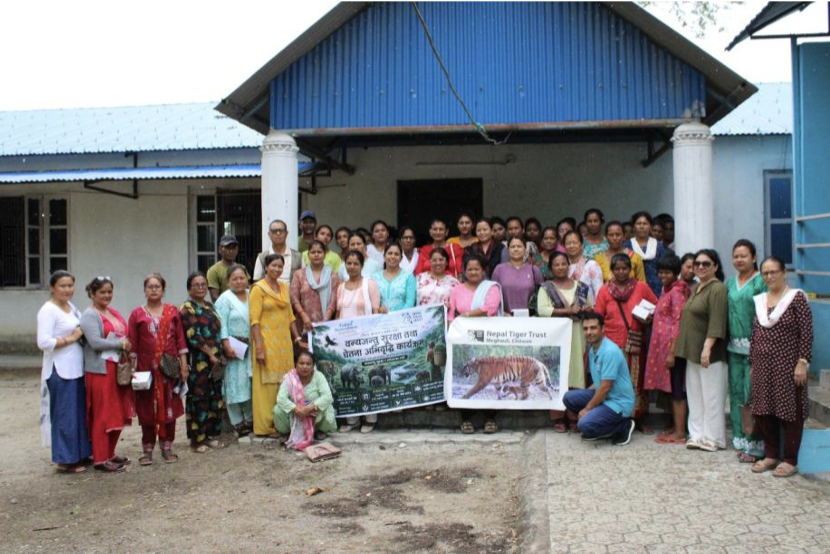
- Wildlife safety and awareness: focus groups offered discussions on previous human-wildlife interactions, while coexistence training provided best practices and risk reduction techniques for future interactions. Educational materials were distributed across the community, while the Women Nature Guardians/Community Rapid Response concept training sessions were established to increase the capacity for emergency preparedness. From here, attack scenarios and first aid exercises were carried out simultaneously alongside harmony circles to provide repeatable, locally appropriate, and community-led solutions.
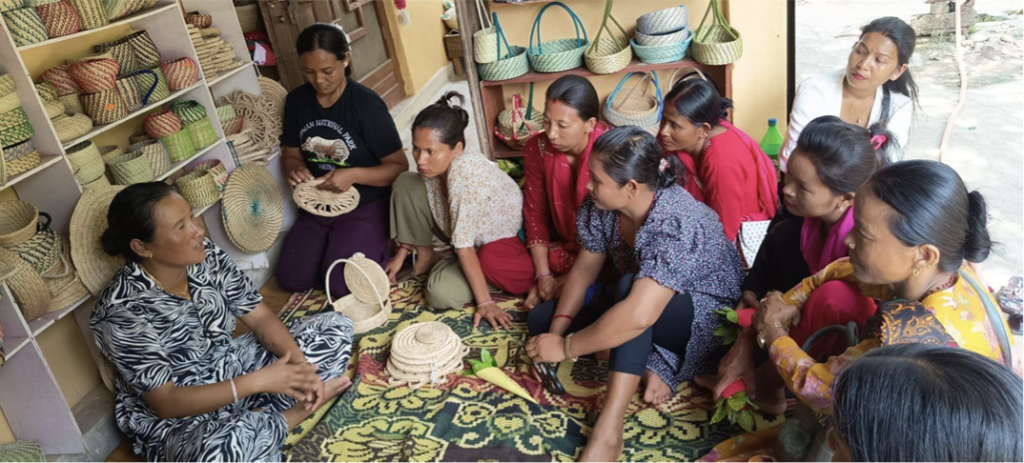
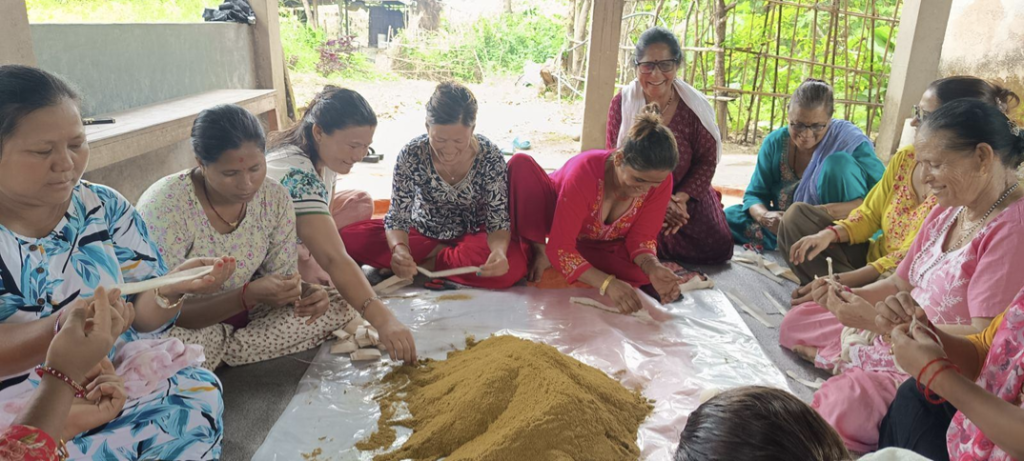
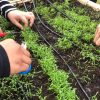
- Conservation-linked livelihood activities: Bateko Dhup, a traditional and handmade rope incense from Nepal, was crafted in class settings, allowing many women of the community to take part in the household-level production of the incense. This provides a money saving opportunity to these women, who no longer need to purchase it elsewhere. Enterprise exposure visits allowed women to exchange learning techniques and plan for future business endeavors. The development of a women-led community seed bank covered the collection of indigenous seeds, seed loss and storage, and record-keeping and resilience practices, while consultations on sustainable farming practices addressed the mounting challenges of climate change and natural drought, flooding, pests, and disease.
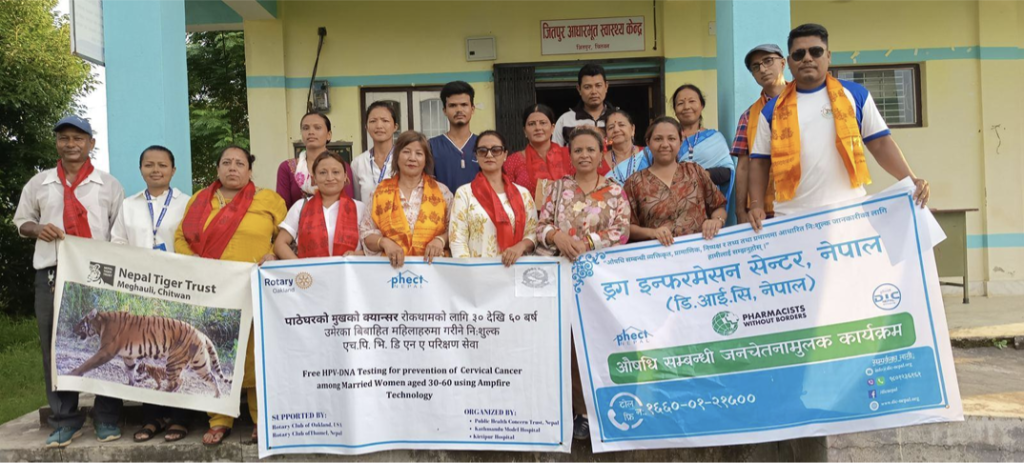
Free community health camp: Here, both men and women attended health check-ups, consultations, health education seminars, and were provided HPV-DNA testing for cervical cancer prevention. This health camp focused primarily on marginalized groups who are more likely to hesitate to seek medical care. Through this activity, the Initiative discovered the value in genuine community engagement via trust, mutual respect, and attention to people’s wider wellbeing.
Key Results and Outcomes
The work of Gauri Malakar and members of the Women, Nature, and Peace Initiative has, in the short-term, improved risk awareness and best practices for wildlife encounters and damage relief, and strengthened community-level emergency preparedness capacity. Further, the women of the Menghauli Buffer Zone have increased their capacity for livelihood protection and alternative income generation while creating resiliency across existing resources. And, perhaps above all else, the work that Gauri led has, in itself, generated increased trust and community engagement among its most marginalized and vulnerable members.
Because of Gauri’s belief in community-based development, some 200 women from communities living close to forests and wildlife habitats took part in wildlife safety training, 150 in initial focus group discussions, 40 in Women Nature Guardians/Community Rapid Response Team training, and 32 in the Sisabas follow-up preparedness and harmony circle session. Average knowledge on the topics of wildlife behavior and safety, conservation and livelihood skills rose from 54.1% to 68%, with 97% of participants showing improvement over the duration of the initiative.
A Living Example of ‘Building on Success’
As SEED-SCALE builds on existing successes, so too does Gauri’s Initiative, where she scales the initiative’s early success with additional activities including: wildlife trainings, mentorship and mock exercises, coordination of community pillars, emergency preparedness capacity expansion, and the continued development of the community seedbank. As outlined by Gauri’s exceptional work, the women of these communities are not mere beneficiaries of conservation programs. Their knowledge, leadership, experience, and priorities are central and critical to finding practical, sustainable coexistence solutions. Their discoveries build a better community for themselves and stand as examples for broader community action across the region and world.
What happens at the intersection of conservation, livelihood, safety, and peace?
Just and lasting change for the better.
To learn more about Gauri Malakar and the many influential alumni of Future Generations University, visit future.edu/alumni.
About Gauri Malakar
Based in Kathmandu, Nepal, Gauri Malakar is a conservation and community development leader whose work spans from the tropical plains of Chitwan to the remote highlands of Dolpa. With over 25 years of experience in wildlife tourism and environmental education, she has advanced initiatives through Global Inclusive Adventure Organization Nepal, Nepal Tiger Trust, WWF Nepal, and Future Generations Himalaya.
Her early career combined hospitality in wildlife tourism with conservation education in Chitwan and Bardia National Parks. She volunteered for nine months as a teacher in Dolpa, gaining first-hand insight into sustainable development challenges in one of Nepal’s most isolated regions.
During her Master’s studies at Future Generations University, she applied the SEED-SCALE methodology across diverse projects:
- Strengthened 24 women’s groups (400+ women) in Dolpa with conservation and livelihood training.
- Coordinated a Female Leadership Academy in Sindhupalchok, training 200 young women in English, computing, and trekking; 40 are now licensed guides.
- Led conservation education in Dolpa and Chitwan.
- Delivered climate adaptation workshops for women in Sindhupalchok on reforestation and sustainable farming.
- Documented 20 resilience stories in Dolpa and Sindhupalchok through Success Mapping.
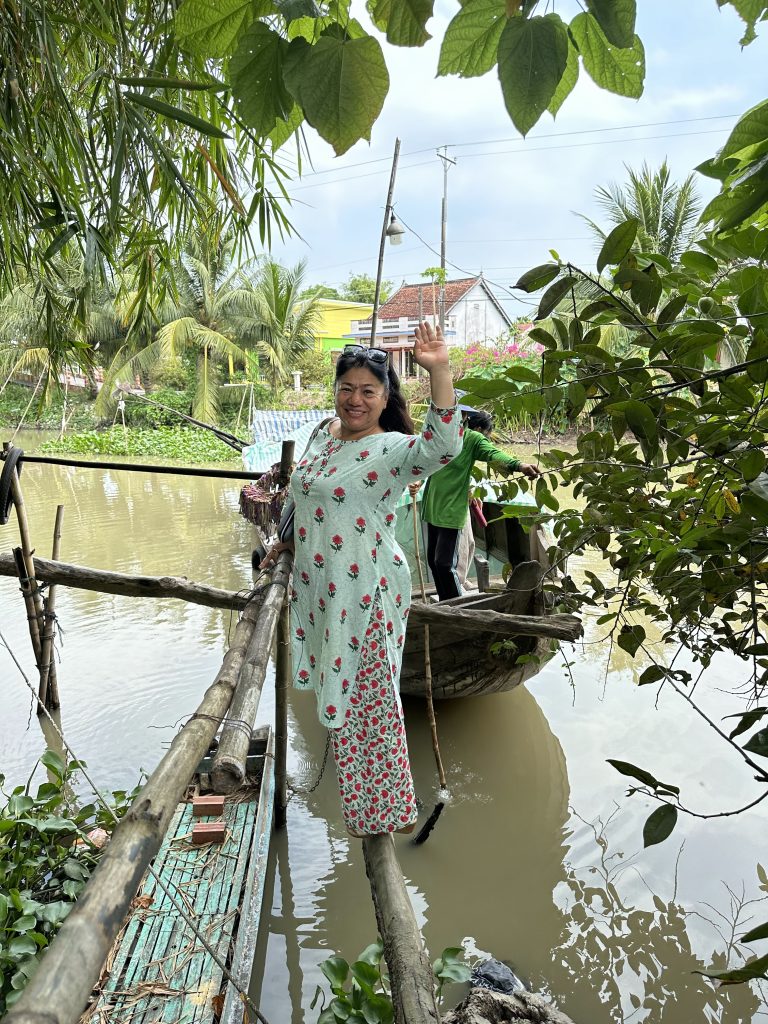
Her academic learning was further deepened through field residencies in Vietnam, on Vietnamese sustainability and resilience; India, studying Gandhian development models and regional peer exchange; and the USA, on the storytelling of Appalachia.
Gauri continues to volunteer and consult on conservation and women’s empowerment, applying her expertise in program design, monitoring, and community mobilization.
As she reflects, “The landscape teaches you, but the people show you how to walk it with purpose.”